
Why do employees sometimes hide that they use artificial intelligence? Does AI bring greater freedom or additional pressure? And why does the success of technological changes depend more on trust and psychological safety than on the tools themselves?
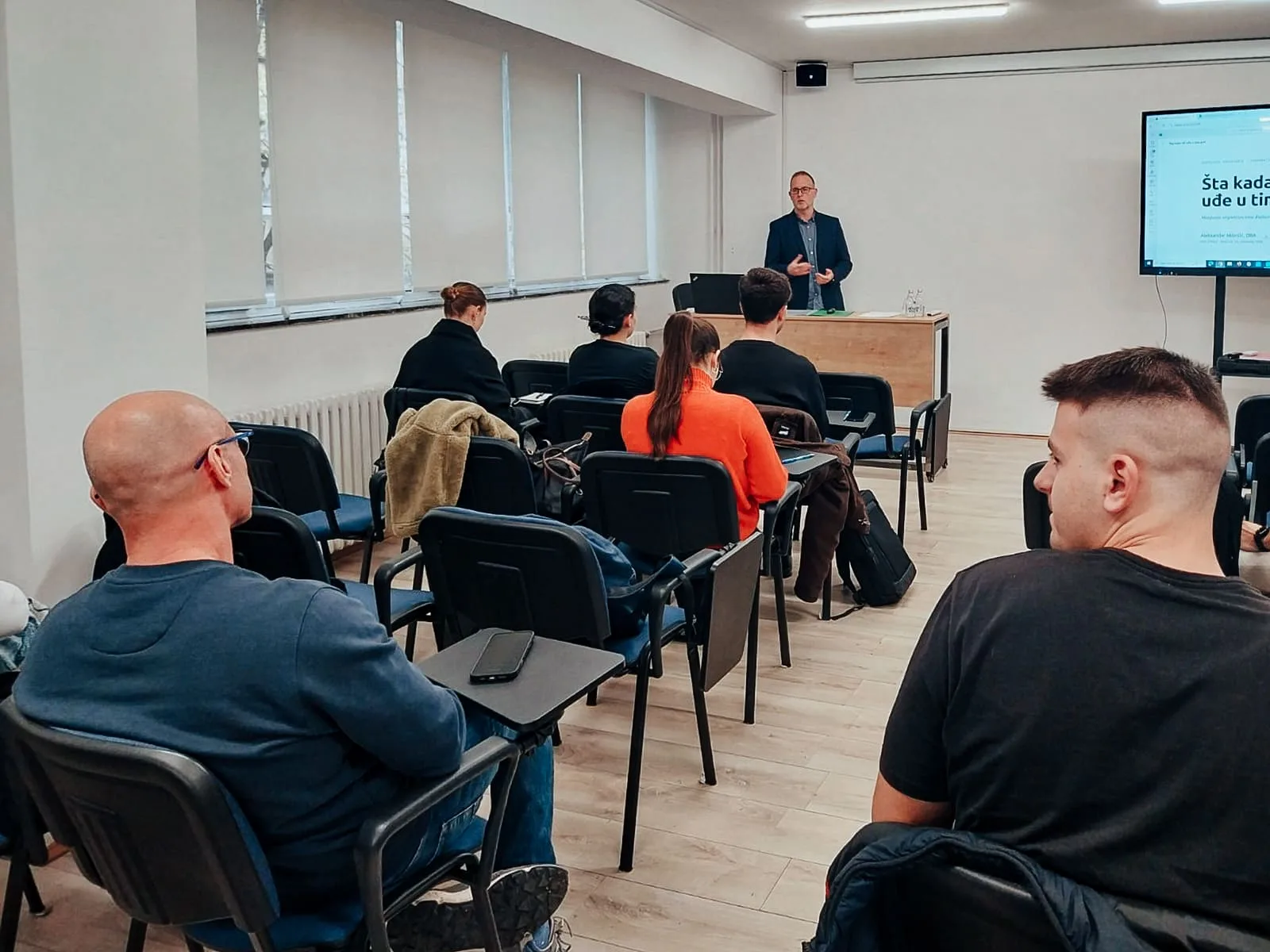
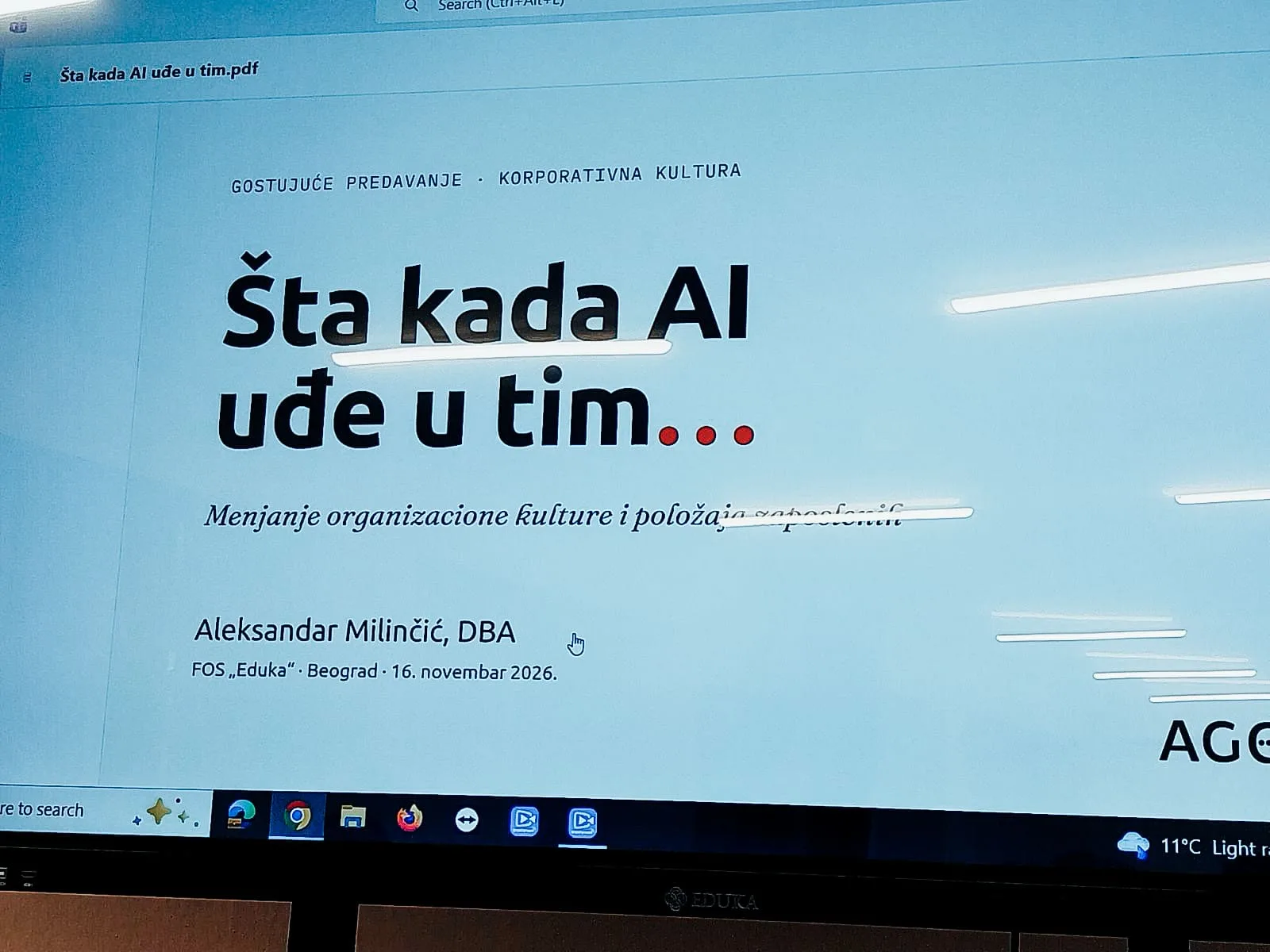
These questions were discussed by Aleksandar Milinčić, DBA , during a guest lecture titled "What Happens When AI Enters the Team: Changing Organizational Culture and Employee Positions," held on November 16, 2026, at the Faculty of Organizational Studies "Eduka" in Belgrade, as part of the course Corporate Culture .
Milinčić, who has extensive experience in leadership positions in the software industry and currently works as a fractional COO and executive coach , connected contemporary trends in artificial intelligence development with the psychological and organizational challenges of its application.
AI Increases Efficiency, But What Happens to Employees?
After an introductory presentation on how modern AI models function, their capabilities, and limitations, the lecture focused on issues of trust, psychological safety, organizational culture, and changes in employee positions.
Special attention was given to the findings of Milinčić's doctoral research, conducted among 328 employees from nine countries, along with 14 interviews. According to the presented results, the application of AI can contribute to greater openness to innovation and freedom to propose ideas, but at the same time brings new pressures, the need for continuous learning, and insecurity regarding one's own competencies.
One of the key findings of the research is that changes in organizational culture are not solely determined by the practical benefits of technology, but also by how employees perceive their work environment – how much support they have, the freedom to express opinions, and opportunities to learn.
Why Do We Hide That We Use AI?
The speaker paid special attention to an interesting paradox of modern work: although organizations encourage the use of artificial intelligence, employees sometimes reluctantly admit that they use it.
The reason may be the fear that colleagues and managers will perceive them as less competent, less motivated, or more easily replaceable. This phenomenon raises important questions about organizational trust, fairness, and the psychological contract between employees and employers.
The lecture also covered various sources of uncertainty among employees – from the fear of losing control over work tasks to concerns about changes in professional roles and the transfer of knowledge between more experienced and younger colleagues.
Managers as Culture Creators, Not Just Controllers
Speaking about the role of management, Milinčić emphasized the importance of clear rules for using AI, ethical guidelines, training tailored to different jobs, and maintaining human responsibility for decisions.
One of the central messages of the lecture was:
"AI changes how we work, but culture changes what people feel while working with it."
A particularly interesting part was dedicated to the new field of machine psychology , which uses psychological concepts and experimental approaches to study the behavior of AI systems. This opens up new opportunities for psychologists to contribute to understanding and shaping technologies that increasingly become part of the work environment.
Aleksandar Milinčić's guest lecture brought an important fact closer to students: the introduction of artificial intelligence is not just a technological issue, but also a matter of human relationships, organizational values, and the quality of leadership.