Why are conspiracy theories so appealing? What drives us to believe in explanations that often defy evidence? And can psychology help us reevaluate our own beliefs?
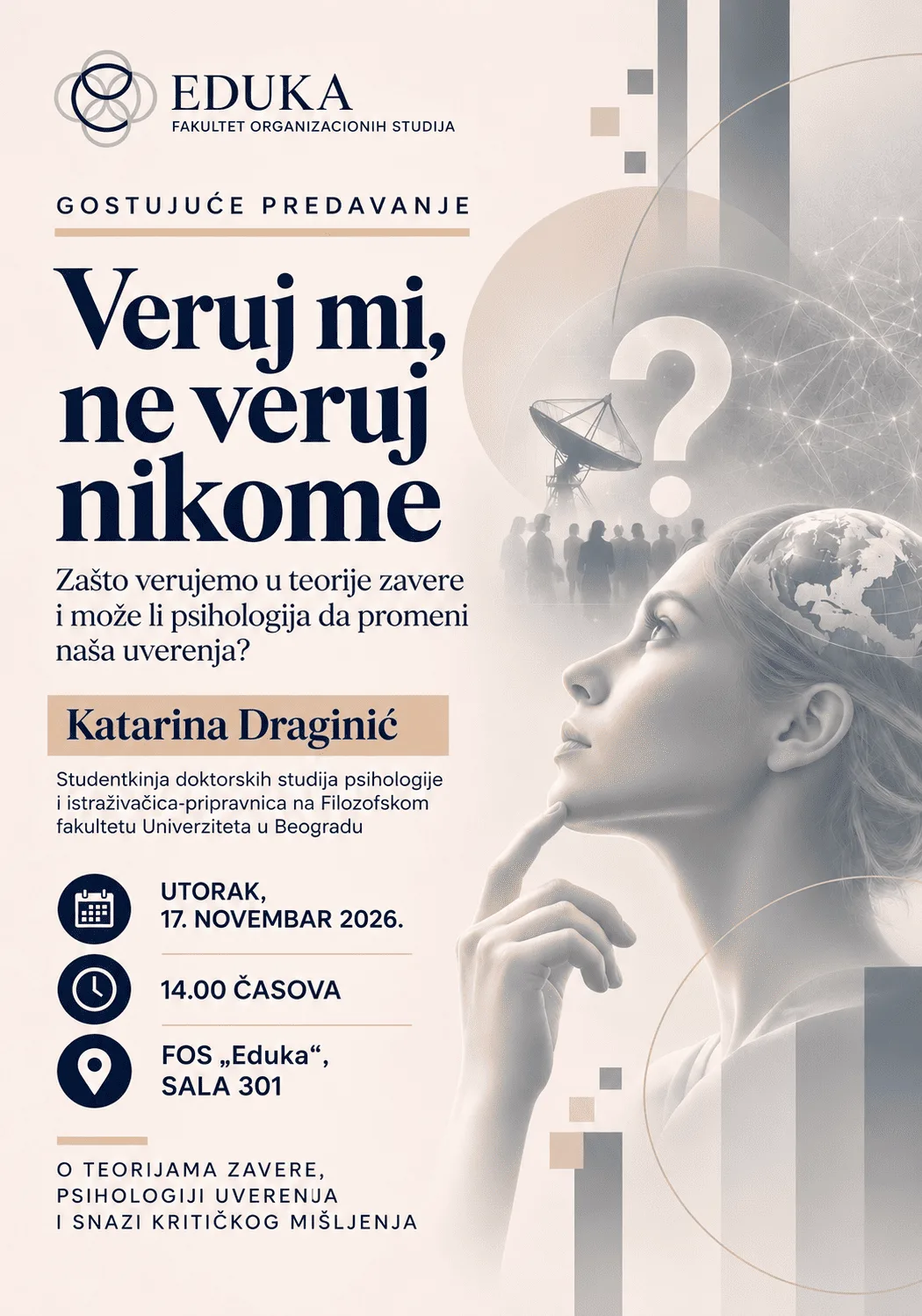
The Faculty of Organizational Studies "Eduka" is organizing a guest lecture titled "Trust me, trust no one" – about conspiracy theories and psychological interventions aimed at reducing such beliefs, which will be held on November 17, 2026, starting at 2 PM.
In an age when information spreads faster than ever, and the line between facts, interpretations, and misinformation becomes increasingly blurred, understanding the psychological mechanisms that shape our beliefs takes on special significance. During the lecture, students will have the opportunity to discover how psychologists define and study conspiracy theories, what cognitive and social factors contribute to their acceptance, and how successful psychological interventions are in reevaluating them.
Special attention will be given to an intriguing research question: What do people actually mean when they say they believe in a conspiracy theory? Through contemporary scientific knowledge and research findings, the lecture will open up space for discussion about critical thinking, the psychology of belief, and the challenges of changing such beliefs.
The guest lecturer, Katarina Draginić , is a doctoral psychology student and a research intern at the Faculty of Philosophy, University of Belgrade. She is a member of the LIRA laboratory, and her research focuses on the social-psychological foundations of belief in conspiracy theories and the possibilities for changing such beliefs. She is the recipient of the Katarina Marić Foundation award for the best master's thesis in psychology for 2024, for her research "And how does it all really happen? The consequences of confronting people with the imperfections of conspiratorial explanations of events they believe in".
The lecture represents an opportunity for students of FOS Eduka, especially psychology students, to connect theoretical knowledge with current scientific research and develop a critical attitude towards the information and social phenomena that shape the modern world.
See you on November 17 at 2 PM – because understanding what we believe begins with the question of why we believe it.